

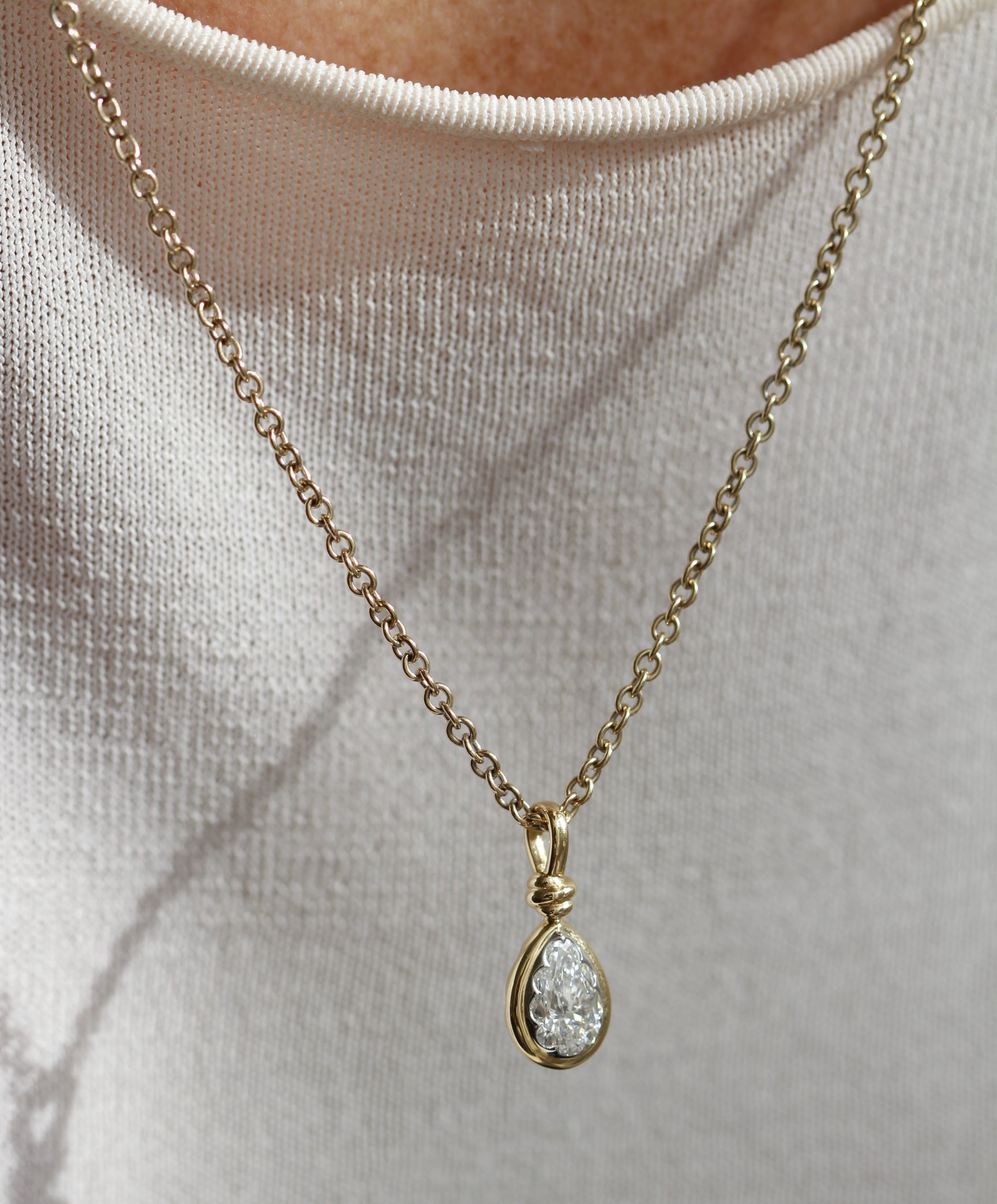

A Guide to Pearl Types: South Sea, Akoya, Mother of Pearl and More
Pearl jewellery has been worn for longer than almost any other form of adornment — and yet most people buying it for the first time find the terminology surprisingly confusing. South Sea. Akoya. Mother of pearl. Baroque. Natural. Cultured. These words appear on product pages and in jewellery store conversations, often without explanation.
This guide is written to cut through that confusion. Sarah Hutchings — founder of Orsini Fine Jewellery and the person who selects every piece carried in our Parnell boutique — has sourced pearl jewellery from Italian ateliers for over fifteen years. What follows is a straightforward explanation of the main pearl types, what distinguishes them, and how the Italian houses we carry at Orsini work with each one.
Natural pearls versus cultured pearls
This is the first distinction worth understanding, because it underpins everything else.
- A natural pearl forms without any human involvement. An irritant — a grain of sand, a parasite, a fragment of shell — enters a mollusc and the animal coats it in layers of nacre, the crystalline substance that gives pearls their lustre. Natural pearls of meaningful size and quality are extraordinarily rare. Most found in antique and estate jewellery pre-date the twentieth century; wild pearl fisheries have largely been exhausted. When you encounter natural pearls today, they come with significant provenance and significant price tags.
- Cultured pearls are grown with human assistance. A nucleus — typically a small bead — is surgically inserted into a mollusc, prompting the same nacre-layering process. The pearl that results is, in every material and optical sense, a real pearl. The nacre is identical to that of a natural pearl. The difference is in origin and rarity, not in what you are wearing. All fine pearl jewellery sold today — including every piece at Orsini — is cultured pearl.
South Sea pearls
- South Sea pearls are grown in the Pinctada maxima oyster, the largest pearl oyster in the world, in the warm waters of Australia, Indonesia, and the Philippines. They are the most substantial cultured pearl by size — typically ranging from approximately 9mm to 20mm — and produce a nacre layer of exceptional depth.
- The result is a lustre that reads differently from other pearl types. South Sea pearls are softer in their glow — creamy, almost lit from within — rather than the high-reflective shine of some smaller varieties. They occur naturally in white, cream, and golden tones, the golden variety most commonly associated with Philippine and Indonesian harvests.
- Marco Bicego uses South Sea pearls in the Africa collection — specifically in the Africa Ball Earrings and the Africa Pearl Pendant, both of which Sarah selected for Orsini after seeing them at the Vicenza jewellery fair. The Africa Pearl Pendant carries an 11–12mm baroque South Sea pearl suspended from a brushed 18-karat gold bail finished using Marco Bicego’s bulino hand-engraving technique. No two pieces are identical; the baroque shape of each pearl means every pendant is, to a degree, its own object.
Akoya pearls
- The Akoya pearl is the pearl most people picture when they think of a classic pearl necklace: round, white, with a high, almost mirror-like lustre. Grown in the Pinctada fucata oyster, primarily in Japan, Akoya pearls are smaller than South Sea pearls — typically between 6mm and 9mm — but produce a nacre with exceptional reflectivity.
- Their brightness comes from the very thin, densely layered nature of Akoya nacre, which creates a sharp, concentrated gleam rather than the diffuse inner glow of larger South Sea and Tahitian varieties. This makes them particularly well suited to classic, architectural settings — studs, pendants, fine chains — where clarity and precision are the point.
- Japanese Akoya pearl cultivation has a long and well-documented history, and the quality grading systems developed in Japan remain the benchmark for the industry globally. When evaluating Akoya pearls, lustre is the primary quality indicator; surface cleanliness and roundness follow.
Freshwater pearls
- Freshwater pearls are grown in mussels in rivers and lakes, primarily in China. Unlike saltwater pearls — which are generally nucleated with a bead and produce one pearl per mollusc — freshwater mussels can produce multiple pearls simultaneously, which has historically made freshwater pearls more accessible in price.
- Quality in freshwater pearls varies considerably. At the lower end of the market, freshwater pearls can appear chalky, irregular, and poorly matched. At the upper end — and this is a range that has improved significantly over the past two decades — high-grade freshwater pearls produce strong lustre, near-round shapes, and a surface quality that can rival saltwater varieties.
- For fine jewellery purposes, the most important thing to know about freshwater pearls is that quality is not a given; it must be evaluated piece by piece. The pearl jewellery at Orsini is sourced from Italian ateliers where stone and gem selection is part of the craft — not assembled from commodity supply.
Tahitian pearls
- Tahitian pearls are grown in the Pinctada margaritifera oyster — the black-lipped oyster — in the lagoons of French Polynesia, most notably around the islands of Tahiti, Fakarava, and Rangiroa. They are the only pearl that occurs in deep, dark tones naturally, without any treatment or dye: charcoal, aubergine, forest green, peacock, deep grey.
- The term “black pearl” is commonly used, but the range of natural colour in Tahitian pearls extends well beyond black. Peacock — a dark green-grey with rose overtones — is widely regarded as the most desirable colour in the category. The pearls range from approximately 8mm to 16mm and carry a lustre that reads differently from white pearls: deeper, more complex, with overtones that shift in different light conditions.
- Tahitian pearls suit bold settings and confident wearing. They work against dark winter fabrics in a way that white pearls do not — and that contrast is worth considering when building a jewellery wardrobe for the Auckland autumn and winter months.
Mother of Pearl explained
- Mother of pearl — also called nacre in its raw form, or MOP in jewellery shorthand — is not a pearl at all. It is the inner lining of certain mollusc shells: the same crystalline substance that pearls are made of, harvested as a flat material and cut into cabochons, inlay pieces, or carved elements.
- Because it comes from the shell rather than a growth formation, mother of pearl does not have the three-dimensional depth of a cultured pearl. What it has instead is a flat, iridescent surface quality — a shifting play of white, cream, silver, and sometimes pink or blue — that works exceptionally well in jewellery with strong graphic shapes.
- Marco Bicego uses mother of pearl extensively in the Siviglia and Lunaria collections. In Siviglia, oval MOP cabochons alternate with brushed 18-karat gold discs along a necklace chain — a rhythm that Marco Bicego has been developing in the Vicenza workshops for years. In Lunaria, named for the Balkan honesty plant, MOP is used in large disc pendants that balance the weight of brushed gold. Nanis uses mother of pearl similarly in the Dolcevita collection — oval cabochons set in brushed 18-karat gold, worn with the understated certainty of someone who has decided exactly what she wants to wear that day.
Baroque pearls
- Baroque is not a pearl type — it is a shape classification. A baroque pearl is any cultured or natural pearl that is not round. The term covers a wide range of forms: drop shapes, button shapes, asymmetric lumps, keshi pearls (which form without a nucleus), and everything in between.
- In fine jewellery, baroque pearls have moved well beyond being a “second choice” to a round pearl. Their irregular surfaces catch light at multiple angles simultaneously; their organic forms suit handcrafted settings in a way that perfectly round pearls do not. The Africa Pearl Pendant from Marco Bicego is an example: the baroque South Sea pearl is not a flaw in the design — it is the design. The hand-engraved gold bail is built to hold an object that is never going to be perfectly symmetrical, and the result is more interesting for it.
- When Sarah is selecting pearl pieces in Vicenza, baroque forms are often where the most individual pieces are found — the ones that reward close attention.
How to care for pearl jewellery
- Pearl nacre is softer than most gemstones and more sensitive to chemicals. A few straightforward habits protect it well.
- Pearls should be the last thing you put on before leaving the house and the first thing you remove when you return. Perfume, hairspray, and cosmetics all contain compounds — alcohol, acetone, acids — that can dull nacre over time. Put your pearls on after these products have been applied and had a moment to settle.
- Wipe pearl jewellery with a soft, dry cloth after wearing. Skin oils and moisture from the atmosphere accumulate on the surface; a brief, gentle wipe removes them before they can affect the nacre. Avoid any abrasive cloth or jewellery cleaning solution unless it is specifically formulated for pearls.
- Store pearl jewellery separately from harder gemstones. Diamonds, sapphires, and other hard stones will scratch nacre if they are kept in contact with it in a jewellery box or travel pouch. A soft pouch or a lined compartment is sufficient.
- Mother of pearl is slightly more durable than cultured pearl in everyday use — the flat surface has less exposure to direct contact than a round pearl — but the same basic rules apply.
- If you have questions about caring for a specific piece, the team at Orsini in Parnell can advise you directly.
Discover Pearl jewellery at Orsini
- Orsini carries pearl jewellery from three Italian houses: Marco Bicego, Nanis, and Chantecler. Each approaches pearl differently, and the range reflects that.
- Marco Bicego’s pearl work is rooted in the Africa and Siviglia collections — a single baroque South Sea pearl in brushed gold in one case, a rhythmic alternation of oval mother of pearl and gold discs in the other. Both are made in the Marco Bicego workshops in Vicenza, using techniques the house has refined over decades. Sarah brought the Africa and Siviglia collections to Parnell because they represent something specific: the Italian confidence to let a single material carry an entire design.
- Nanis works with mother of pearl in the Dolcevita collection — oval MOP cabochons in brushed gold, worn with the kind of quiet certainty that defines Italian dressing at its best. The Nanis Muse range extends this further, with boule pendants and layering pieces that build on the same material and craft logic.
- Chantecler has made jewellery on the island of Capri since 1947. Their pearl pieces carry that heritage — confident, considered, and entirely indifferent to trend. We recommend visiting the boutique to see Chantecler’s current pearl range, as pieces vary with availability.
- Browse the full pearl jewellery collection at Orsini, or visit us at 241 Parnell Road, Parnell, Auckland to see the current range in person.


How should I store pearl jewellery at home?
Store pearl jewellery separately from harder gemstones — diamonds and sapphires will scratch nacre if they are in direct contact. A soft cloth pouch or a lined jewellery compartment is ideal. Keep pearls away from strong light and heat, which can dry and crack the nacre over time. If you are storing pieces you wear less frequently, a light wipe with a clean cloth before storage removes any residue that could affect the surface.
Can I wear pearl jewellery every day?
Yes — cultured pearls and mother of pearl are both well suited to regular wear, provided you follow a few basic guidelines. Put pearls on last, after perfume and cosmetics. Wipe them gently after wearing. Avoid contact with chlorine, acids, and abrasive surfaces. Marco Bicego’s pearl settings — brushed 18-karat gold bezels in both the Siviglia and Africa collections — are designed for daily wear, not display cabinets.
What is the difference between a cultured pearl and a natural pearl?
A natural pearl forms without human involvement — a wild irritant enters a mollusc and the animal produces nacre around it over several years. Natural pearls of quality and meaningful size are exceptionally rare today, and most appear in antique and estate jewellery. A cultured pearl is grown with a nucleus inserted by a pearl farmer, prompting the same nacre-forming process in a managed environment. The nacre of a cultured pearl is materially identical to that of a natural pearl. All fine pearl jewellery sold today — including every piece at Orsini — is cultured.
What makes South Sea pearls different from other pearl types?
South Sea pearls are grown in the largest pearl oyster species in the world and produce a nacre layer of exceptional thickness. This gives them their characteristic lustre — a soft, creamy, almost interior glow — and their larger size, typically from 9mm upward. They are grown primarily in the warm waters of Australia, Indonesia, and the Philippines. Marco Bicego uses South Sea baroque pearls in the Africa collection, which Sarah Hutchings selects for Orsini directly from visiting Italy.

Sarah Hutchings
Sarah Hutchings is the founder, curator and bespoke jewellery designer at Orsini Fine Jewellery in Parnell, Auckland. With nearly 20 years in fine jewellery, Sarah travels annually to Italy — through Vicenza, Milan and beyond — to source exceptional pieces from brands including Pomellato, Marco Bicego, Al Coro and Chantecler. Her deep relationships with Italian makers inform both her curation and her bespoke design work at the Orsini atelier. Our Story →
Some pieces have to be seen in daylight.
Photographs flatten fine jewellery. Book a private hour at our Parnell Atelier — our private design space above the boutique — and we will set aside the pieces worth seeing.
More from the journal

Pearl Jewellery with Italian style
A modern take on Pearl with Italian jewellery designs available at Orsini

The Orsini Guide to Choosing the Perfect Gold Necklace
In this guide we help you choose the perfect gold necklace

The Comprehensive Guide to Choosing Your Perfect Wedding Ring
In this post Orsini provides our guide to choosing the perfect engagement ring
